
Flagship report · 2023/24 season
The season the rains never came.
Zambia's driest agricultural season in more than forty years, reconstructed from official surveys, satellite rainfall and humanitarian assessments, every figure open, sourced and queryable.
How it unfolded
From a late start to a national emergency.
An intense El Niño pushed the rains weeks late, then cut them off entirely during January and February, precisely when maize flowers and fills. In Agro-Ecological Region I and IIa, dry spells stretched past five weeks. By the end of February the government had declared a national disaster; by May the Crop Forecast Survey confirmed what farmers already knew.
Kariba reservoir fell to critically low usable storage; load shedding reached up to 21 hours per day in late 2024 (hydro ≈ 80% of national generation).
Query this dataset → /api/v1/drought/2024- 15 Oct 2023climate
Late onset of 2023/24 rains
Seasonal rains arrive late across the southern half of Zambia as a strong El Niño develops over the Pacific.
- 20 Jan 2024climate
Prolonged mid-season dry spell begins
Dry spells of 3-5+ weeks strike during the crucial vegetative and flowering stages of maize, the point of no return for much of the crop in Agro-Ecological Regions I and IIa.
- 29 Feb 2024government
National disaster declared
President Hakainde Hichilema declares the drought a national disaster and emergency, mobilising government and international response.
- 15 Apr 2024assessment
DMMU Drought Response Plan
The Disaster Management and Mitigation Unit publishes the Food Security Drought Response Plan: 84 of 117 districts affected, around 9 million people impacted.
- 10 May 2024assessment
Crop Forecast Survey confirms crop failure
982,765 of 2,272,931 hectares of planted maize destroyed (43%). National maize production falls to about 1.5 million tonnes, down more than half from 2023 and the lowest in years.
- 20 May 2024humanitarian
UN Flash Appeal launched
OCHA launches a US$228 million drought response appeal to complement the government-led response.
- 1 Sept 2024energy
Energy crisis deepens
Kariba's usable water storage collapses; ZESCO load shedding extends to as much as 21 hours per day, hitting irrigation, agro-processing and cold chains.
- 1 Nov 2024assessment
Peak lean-season food insecurity projected
IPC projects 5.8 million people (33% of analysed population) in high acute food insecurity for October 2024 - March 2025, including 236,000 in Emergency (Phase 4), 186% higher than the previous year.
- 15 Jan 2025climate
2024/25 rains return
A favourable La Niña-leaning season brings normal to above-normal rainfall across most provinces, setting up recovery.
- 22 May 2025assessment
Record recovery harvest
The 2024/25 Crop Forecast Survey announces a record maize harvest of about 3.66 million tonnes, a 142% rebound from the drought year.
The collapse, and the rebound
national maize, tonnes · ZamStats CFS · 2024 in red
Share of planted maize never harvested
by province, small & medium farms · IAS 2024 (official)
The herd contraction
national livestock · surveys 2018-2024 · cattle −22% in one year
The human cost
people in acute food insecurity · IPC analyses 2022-2026
Province by province, the official record
maize, 2023/24 season, small & medium farms · 2024 Integrated Agriculture Survey, ZamStats
| Province | Planted (ha) | Harvested (ha) | Lost | Production (t) | Yield (t/ha) |
|---|---|---|---|---|---|
| Southern | 455,970 | 48,171 | 89.4% | 25,946 | 0.06 |
| Lusaka | 90,112 | 17,053 | 81.1% | 15,315 | 0.17 |
| Central | 380,894 | 89,978 | 76.4% | 117,084 | 0.31 |
| Western | 230,479 | 58,927 | 74.4% | 33,887 | 0.15 |
| Eastern | 363,917 | 230,164 | 36.8% | 221,446 | 0.61 |
| North-Western | 137,269 | 88,013 | 35.9% | 114,931 | 0.84 |
| Copperbelt | 203,270 | 135,300 | 33.4% | 134,810 | 0.66 |
| Luapula | 80,148 | 69,856 | 12.8% | 148,477 | 1.85 |
| Northern | 147,942 | 129,132 | 12.7% | 287,576 | 1.94 |
| Muchinga | 78,094 | 71,702 | 8.2% | 176,977 | 2.27 |
| Zambia (all sectors) | 2,232,580 | 980,526 | 56.1% | 1,460,148 | 0.65 |
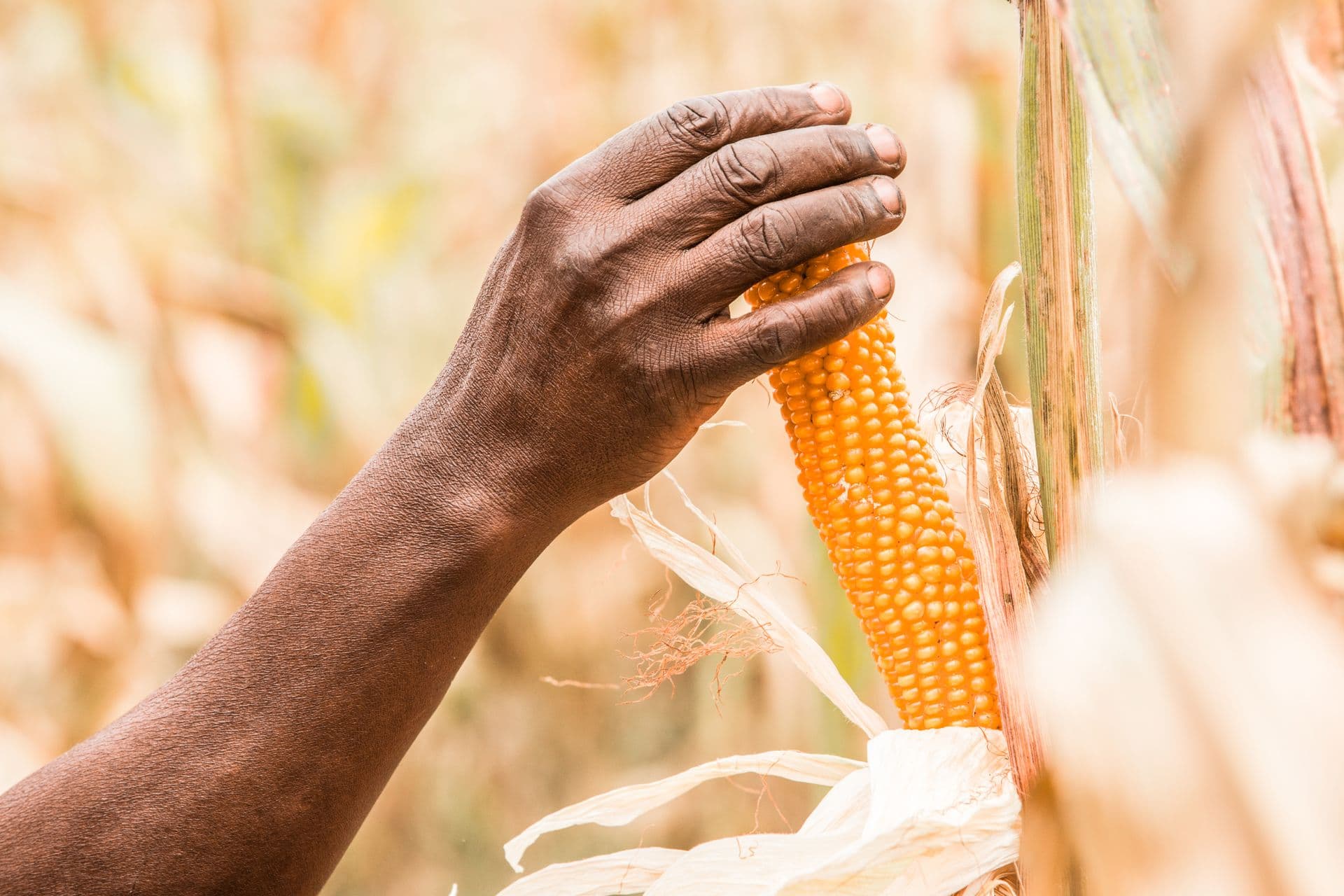
The rebound · 2024/25 season
One good season brought a record 3.66 million tonnes.
Normal rains returned and production rebounded 142%, proof of how fast the sector can recover, and how much depends on seeing the next shock coming. That is exactly what this platform is for.